Stuttgart Meaning: What the City's Name Really Says
The short answer
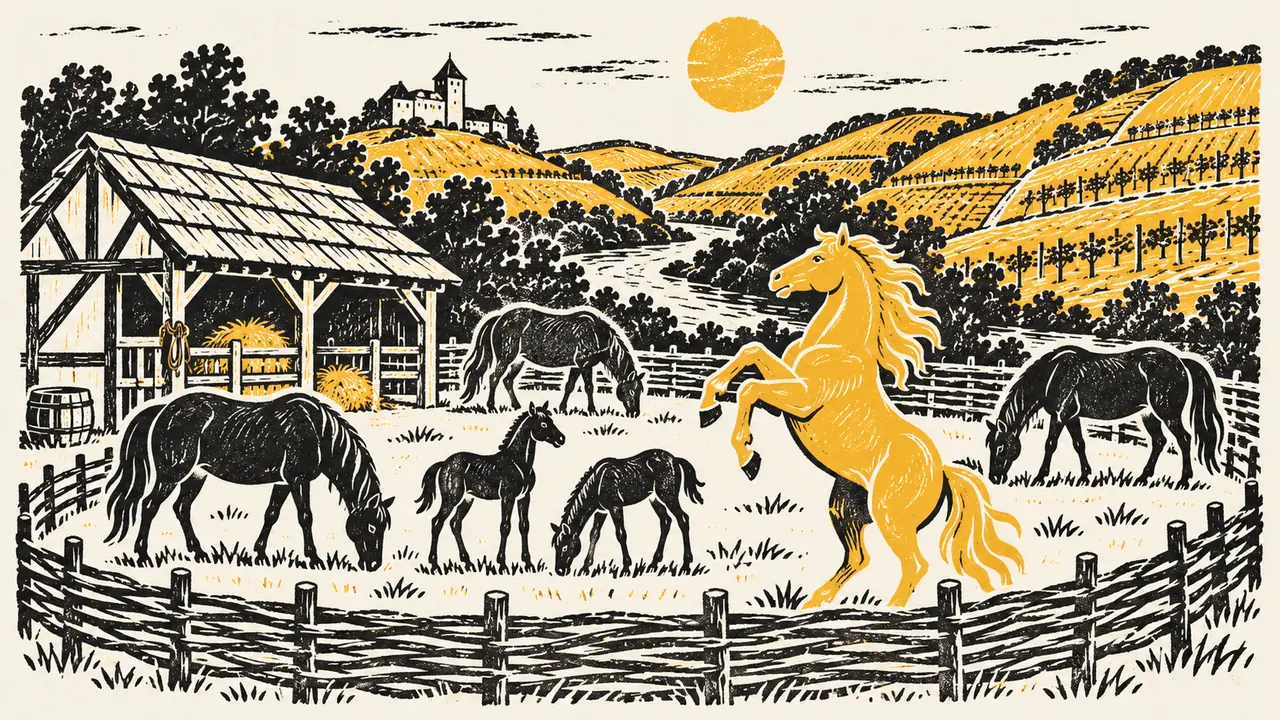
Stuttgart is named after a horse stud. The City of Stuttgart's own history page says the city grew “from the ducal horse stud "Stuotgarten" founded around 950”. The old name is usually explained as stuot, a stud of breeding horses, plus garten, a fenced enclosure, which is where the popular translation “mare garden” comes from.
There is no saint, no founder and no legend in the name: just a fenced meadow with horses in it.
What the two halves mean
| Part | Old High German | Modern sense |
|---|---|---|
| Stuot | a herd of mares, a stud | a breeding stable |
| Garten | an enclosure, a fenced plot | a garden |
Stuot is the interesting half. Its relatives survive in modern German as Stute, “mare”, and Gestüt, “stud farm”, both still about horses kept for breeding. The uo spelling marks it as a medieval form.
How Stuotgarten became Stuttgart
The name was written in more than one way before the modern spelling settled, and over time the long medieval vowel and the -en ending wore away, leaving Stuttgart. The modern spelling has a double t after the u and a single t at the end.
The horse never left the city's identity. A rearing black horse has been the city's emblem for centuries, and it still sits on Stuttgart's coat of arms.
Is it “garden” or “farm”?
“Mare garden” reads oddly in English, and both translations circulate. Garten in Old High German covered any enclosed plot of land, not just the flower beds the modern word suggests — a paddock or a fenced meadow counted. Stuot was specifically a group of breeding mares.
So “stud farm” or “horse enclosure” captures the sense more faithfully than “garden”, even though “garden” is the literal translation. If you only remember one thing, remember horses: the name of Stuttgart is a horse-breeding yard.
Stuttgart and cars
For most English speakers, Stuttgart means cars before it means anything else. Porsche has its headquarters and main factory in the Zuffenhausen district, where the 911 is built, and the Mercedes-Benz Group is headquartered in the city, with its original plant in Untertürkheim next to the Mercedes-Benz Museum. The car story starts here as well: in the 1880s Gottlieb Daimler and Wilhelm Maybach built their early engines in a workshop in Cannstatt, which is now part of Stuttgart.
The horse followed the city into the car age. The prancing black horse at the centre of Porsche's crest is taken from Stuttgart's coat of arms. None of this changes the words themselves: Stuttgart is still the city, named after a horse stud, and a Stuttgarter is still someone from there.
Stuttgart and Stuttgarter are different words
This is where most English readers land, so it is worth separating the two clearly.
- Stuttgart is the city. Place name, one spelling, never used for a person.
- Stuttgarter is a person from Stuttgart, or an adjective meaning “of Stuttgart”. It is Stuttgart plus the suffix -er.
- Stuttgarterin is a woman from Stuttgart.
The relationship is the same as London and Londoner, or New York and New Yorker. The main entry on Stuttgarter covers the grammar in full.
What the name tells you about the city
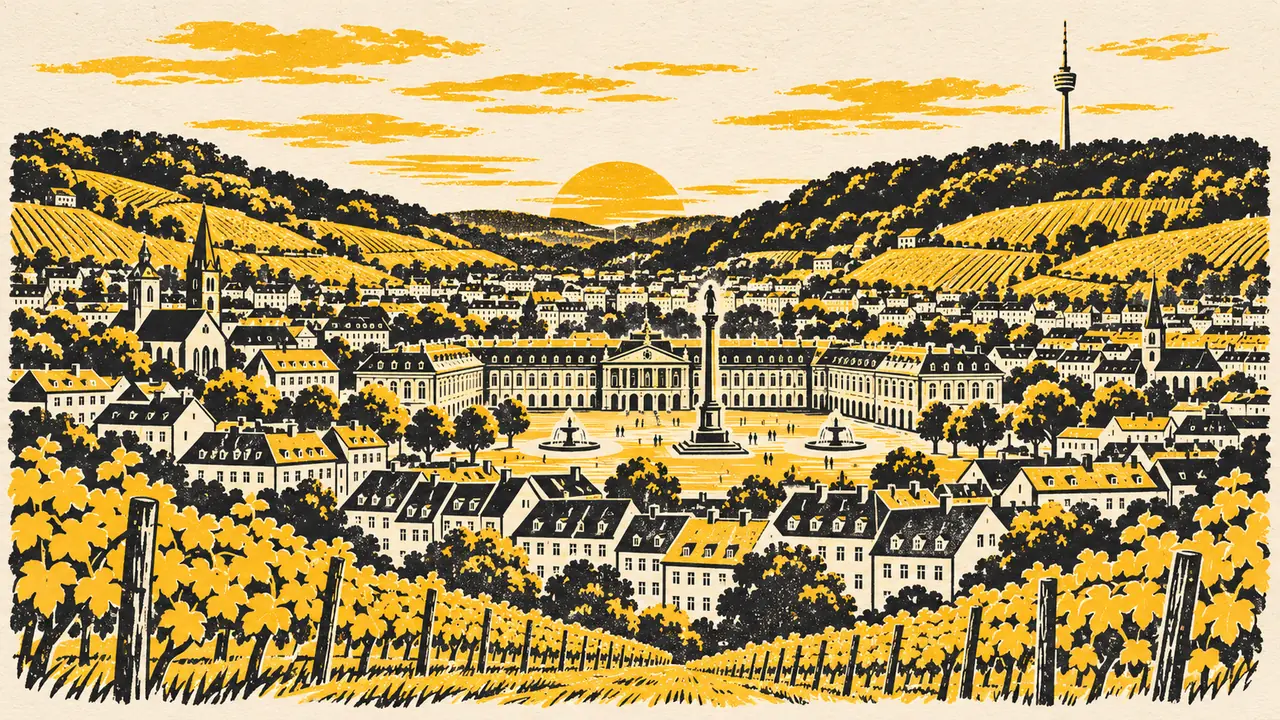
Stuttgart is now the capital of Baden-Württemberg, and vineyards still grow inside the city limits.
The geography still fits the old name. The city centre sits in a basin ringed by hills, which Germans call the Stuttgarter Kessel, “the Stuttgart cauldron”. A sheltered, well-watered valley floor is exactly the kind of ground where a medieval stud made sense.
A note on pronunciation
In German the city is SHTOOT-gart and the person is SHTOOT-gar-ter — the extra syllable at the end is the only difference. American speakers usually say STUT-gart and STUT-gar-ter, dropping the “sh” at the start; Cambridge records the British pronunciation of the city with the “sh” kept. Both are understood, and the pronunciation page has buttons to hear each one.
Questions people ask
What does Stuttgart mean in German?
It comes from Stuotgarten, the name of a ducal horse stud founded around 950. The name is usually explained as stuot, a stud of breeding horses, plus garten, a fenced enclosure, which is why you will see it translated as “mare garden” or “stud garden”.
Is Stuttgart named after a person?
No. The name describes the place: a horse-breeding enclosure on the ground where the city later grew. There is no founder or saint in it.
When was Stuttgart founded?
The City of Stuttgart dates its origin to the horse stud Stuotgarten, founded around 950. The settlement around it grew into a town over the following centuries.
Is Stuttgart where Porsche is made?
Yes. Porsche's headquarters and main factory are in Stuttgart-Zuffenhausen, where the 911 is built, and Mercedes-Benz is headquartered in Stuttgart too.
What is the difference between Stuttgart and Stuttgarter?
Stuttgart is the city. Stuttgarter is a person from Stuttgart, or an adjective meaning “of Stuttgart”: the city name plus the German suffix -er.